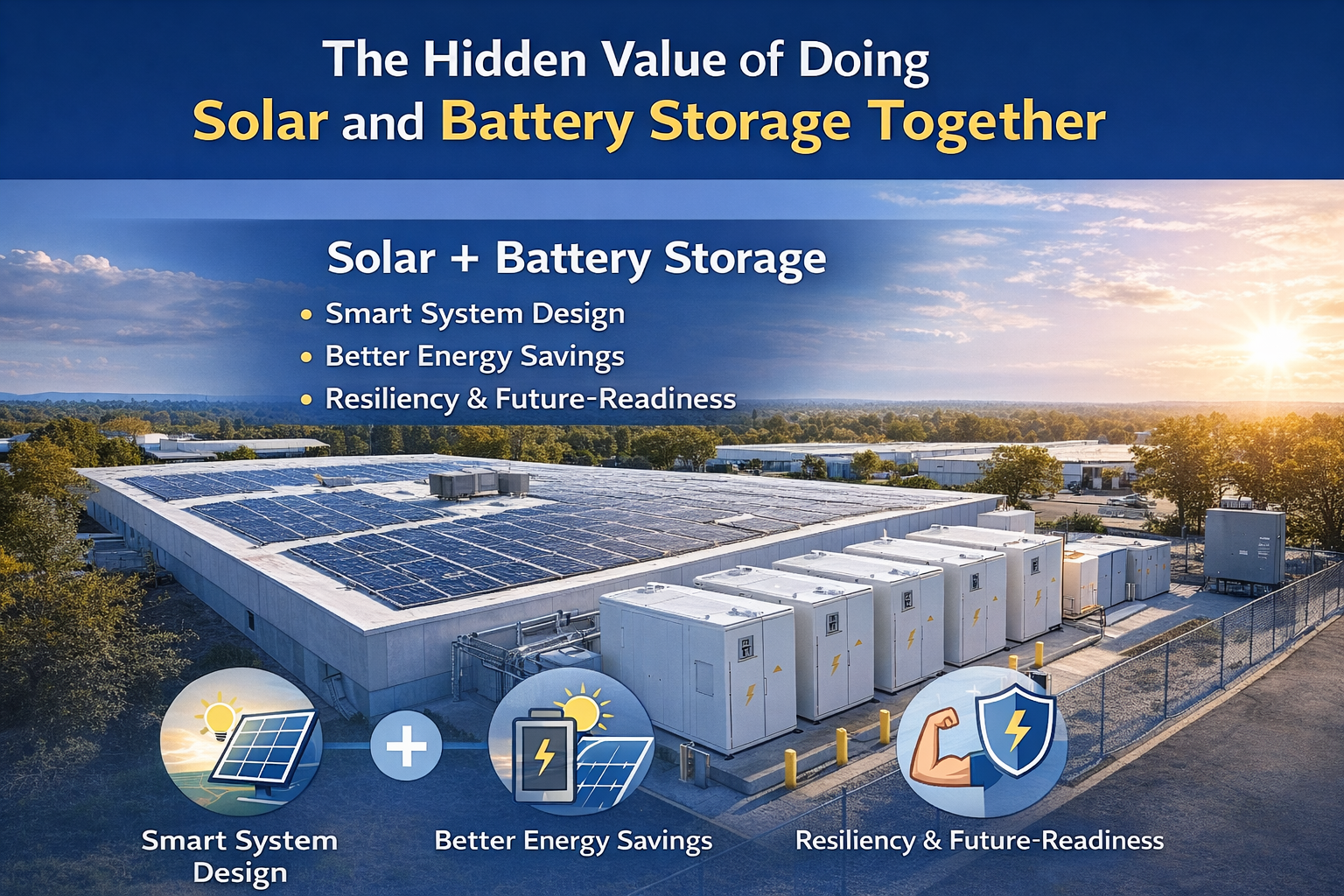
When businesses start looking at energy upgrades, many initially think of solar and battery storage as two separate decisions. In reality, designing them together can create far more value than treating them as independent projects. A commercial solar system reduces the amount of electricity a facility needs to buy from the utility during the day, while battery storage adds flexibility by controlling when and how energy is used. When both systems are planned as one strategy from the beginning, the result is often a smarter, stronger long-term investment.
One of the biggest hidden benefits of pairing solar and battery storage is better overall system design. Instead of installing solar first and then trying to add a battery later, the project team can evaluate the building load profile, utility rate structure, demand charges, and operational goals all at once. This allows the system to be sized and configured more effectively from day one. In many cases, that means better performance, improved energy savings, and fewer costly modifications later.
Another major advantage is that battery storage can help a business get more value out of the solar energy it produces. Solar generation does not always line up perfectly with when a facility needs power the most. A battery can store excess solar production and discharge it when demand is higher, utility rates are more expensive, or the facility needs additional support. This can improve bill savings, reduce peak demand exposure, and give the customer more control over how energy is managed throughout the day.
There is also an important resiliency and future-readiness benefit. Businesses that install solar alone may later realize they want backup capability, energy shifting, demand response participation, or more advanced energy management. Adding storage after the fact can still be done, but it is often more complex and less efficient than planning for it upfront. When solar and battery storage are considered together from the start, the project can be built with future operating goals in mind instead of forcing upgrades into a design that was never intended for them.
At the end of the day, the hidden value of doing solar and battery storage together is not just about adding more equipment, it is about creating a more intelligent energy system. A properly integrated design can improve savings, increase flexibility, support resiliency, and better prepare a business for future utility and grid changes. For many commercial properties, the best long-term solution is not just solar or just storage, but a coordinated strategy that uses both the right way from the beginning.