What Are Microgrids?

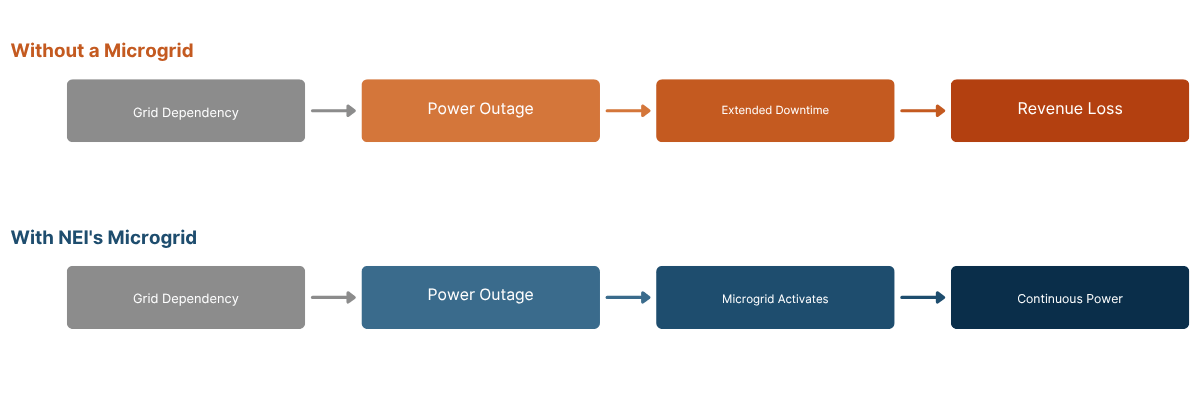
Commercial microgrids are a localized power system that combines on-site generation, battery storage, and automated controls to operate either alongside the utility grid or independently from it. When utility power fails, properly engineered microgrids can island a facility from the grid and keep critical operations running, without waiting on utility restoration timelines.

NEI is a commercial microgrid installer that designs and integrates microgrid controls as part of a unified site energy platform, combining solar, battery storage, natural gas generation, and power distribution into one system engineered and commissioned by NEI’s team.

Commercial microgrid installer

Why It Matters

How It Works

Parallel Microgrid Flow Charts

NEI Delivers

Beyond Battery Backup

A battery can bridge a short outage, but it can’t manage a facility’s full load indefinitely or coordinate multiple power sources on its own. Most providers stop there. NEI’s microgrid controls integrate solar, battery storage, natural gas generation, and power distribution into one automated system that manages the transition the moment grid power fails.

Four Systems Built as One

Solar, battery storage, natural gas generation, and power distribution, integrated by NEI’s engineering team into a single automated platform. Most providers specialize in one or two of these systems. NEI designs all four to work as one.

Engineered Around Your Facility

NEI’s engineering team designs the controls architecture around each facility’s actual load profile and criticality requirements, then commissions it alongside the same team that installs the solar, storage, and generation systems it manages.

Frequently Asked Questions

A commercial microgrid combines on-site generation, battery storage, and automated controls into a system that can operate alongside the utility grid or independently from it. When utility power fails, a properly engineered microgrid can island a facility from the grid and keep critical operations running without waiting on utility restoration.

A standalone generator restores power to select circuits after an outage begins, typically with a short delay. A microgrid coordinates multiple power sources, including solar, battery storage, and generation, and can maintain continuous power through the transition itself, not just after it.

Yes. A microgrid engineered for islanding can disconnect from the grid and keep operating on on-site generation and storage for as long as the system is sized to sustain it. That covers unplanned outages from storms and grid failures, as well as planned utility shutoffs, such as the Public Safety Power Shutoff (PSPS) events California utilities use during periods of high wildfire risk, which the California Public Utilities Commission tracks PSPS activity statewide.

NEI’s controls platform coordinates solar generation, battery charge and discharge, natural gas generation, and power distribution across the facility, automatically managing the transition between grid-connected and island mode without manual intervention. As a commercial microgrid installer, NEI helps build a system that your organization can rely on for years to come.

Healthcare, data centers, and industrial or manufacturing facilities see the clearest return, since each faces real operational or safety consequences from downtime. Commercial real estate and municipal facilities also use microgrids to meet resilience and sustainability commitments.

NEI designs microgrid controls to work with a facility’s existing solar and storage systems where feasible, adding the generation, distribution, and automated controls layer needed to enable full islanding capability.

Let’s Build Your Energy Future

Our team is ready to help you power what’s next sustainably and reliably.