What Is Commercial Natural Gas Generation?

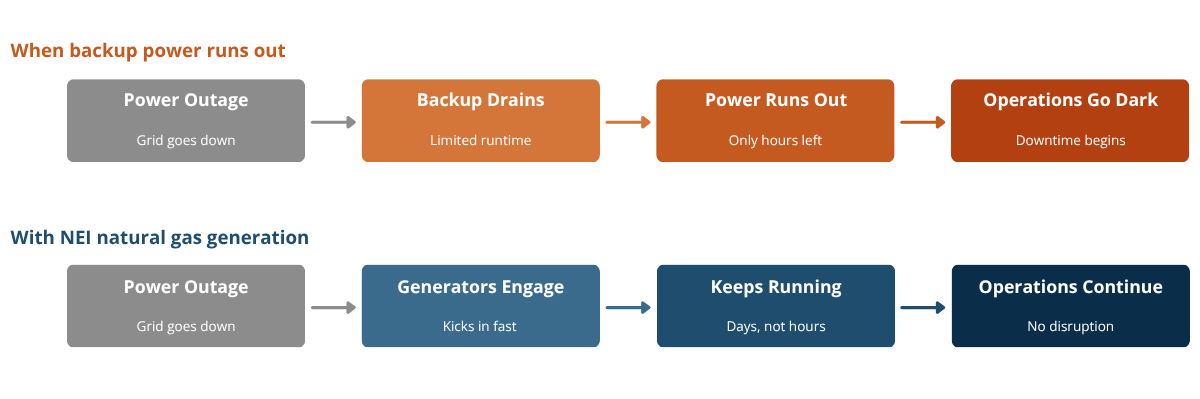
Commercial natural gas generation uses piston or turbine generators to provide on-site power for extended durations, either as backup during outages or as prime power for facilities with limited grid access. Unlike battery storage, which is limited by its charge capacity, natural gas generation can run continuously for as long as fuel supply allows, making it the right fit for facilities that need power for days, not hours. NEI designs and installs natural gas generation as part of a unified site energy platform, integrated with solar, battery storage, and microgrid controls as one engineered system.
Commercial microgrid installer

Why It Matters

How It Works

Parallel Natural Gas Generation Flow Charts

NEI Delivers

Sized To Your Load, Not Oversold

NEI specs piston or turbine generation based on actual facility load and required runtime, not a one-size default. The right system is the smallest one that reliably covers your actual exposure.

Built To Run When The Grid Can’t

Piston and turbine generation is engineered by NEI to integrate with existing solar, storage, and microgrid controls, providing continuous power for as long as an event requires.

Integrated With Your Microgrid Controls

Generation doesn’t operate in isolation. NEI’s controls platform coordinates generation with solar and battery storage automatically, so the transition between power sources happens without manual intervention.

Frequently Asked Questions

Commercial natural gas generation uses on-site piston or turbine generators to produce electricity for a facility, either as backup power during a grid outage or as prime power for continuous, day-to-day operation. Unlike battery storage, which is limited by stored charge capacity, natural gas generation can run for as long as fuel supply allows, making it suited to extended outages and facilities with limited or unreliable grid access. Generator installations in California are subject to air district permitting requirements — CARB provides guidance on emergency backup generator regulations that NEI navigates as part of every project.

Piston generators use reciprocating engines, similar in principle to a large combustion engine, and are typically better suited to smaller facilities or applications that need to start and stop frequently. Turbine generators use continuous rotational combustion and are generally better suited to larger, continuous loads where the system runs for extended periods rather than cycling on and off. NEI specs the right system type based on the facility’s actual load pattern, not a default preference for one over the other.

Battery storage discharges stored energy and is limited by its charge capacity, typically covering minutes to a few hours depending on system size. Natural gas generation produces power continuously as long as fuel is available, making it the right fit for outages measured in days rather than hours. Many NEI systems use both together: battery storage covers the immediate transition, and generation sustains the facility for extended duration.

Yes. While generation is commonly installed as backup for outage events, it can also serve as prime power for facilities with limited grid access, delayed utility interconnection, or operations that require power independent of the grid entirely. NEI designs generation systems for both use cases depending on the facility’s actual power needs.

NEI evaluates a facility’s actual electrical load, critical versus non-critical circuits, and required runtime to determine the right generator capacity, rather than defaulting to an oversized system. The goal is a system sized to reliably cover a facility’s real exposure, not the largest generator available.

NEI’s controls platform coordinates natural gas generation with solar and battery storage as part of a single automated system. When an extended outage occurs, generation sustains the facility’s power needs while solar and storage continue to contribute, all managed by NEI’s microgrid controls without manual intervention.

Let’s Build Your Energy Future

Our team is ready to help you power what’s next sustainably and reliably.